Showing posts with label jeep albright. Show all posts

7 TIPS FOR OVERLANDING DEATH VALLEY


Death Valley Overlanding

Jeep or Car Camping

By Del Albright, Sustainable Motorized Recreation Advocate


Death Valley National Park is an incredible desert environment because it’s one of the most extreme and diverse landscapes in the world.  Much of it can be enjoyed by backcountry camping or overlanding. Just make sure you have whatever necessary permits fit your adventure (entrance fees, tour permits, camping, etc.). 

Death Valley National Park is 3.4 million acres (about 5,270 square miles or 13,650 square kilometers), making it the largest national park in the contiguous United States. It stretches across eastern California and western Nevada and features vast desert landscapes, sand dunes, mountains, and salt flats, including Badwater Basin, the lowest point in North America at 282 feet below sea level.

Here’s why it’s such an amazing place to visit:

1. Unique & Extreme Landscapes

  • Lowest Point in North America – Badwater Basin sits at 282 feet below sea level, creating a surreal salt flat landscape.
  • Towering Sand Dunes – Mesquite Flat, Eureka, and Ibex Dunes offer stunning dune fields perfect for exploration and photography.
  • Colorful Canyons & Rock Formations – Places like Golden Canyon, Mosaic Canyon, and The Artist’s Palette showcase incredible geology with reds, yellows, and purples in the rocks.
  • Massive Mountains – The Panamint Range, including Telescope Peak (11,043 feet), provides high-alpine views contrasting the desert below.

2. Harsh & Beautiful Climate

  • One of the Hottest Places on Earth – Furnace Creek holds the record for the highest temperature ever recorded on Earth (134°F in 1913).
  • Starry Skies – As a designated Dark Sky Park, Death Valley has almost zero light pollution, making for some of the best stargazing in the country.

3. Tons of Adventures

  • Off-Roading & 4x4 Trails – Roads like Titus Canyon, The Racetrack, and Goler Wash are perfect for Jeeps and off-road vehicles.
  • Hiking & Exploring – Trails range from easy walks to tough treks, such as the challenging climb to Telescope Peak.
  • Mysterious Moving Rocks – The Racetrack Playa features eerie “sailing stones” that mysteriously move across the dry lakebed.

"Cousin Jack" miner's cabin, made famous by Cornish and Welch miners of the 1800s.


4. Rich History & Ghost Towns

  • Old Borax Mines & Abandoned Towns – Places like Rhyolite and Harmony Borax Works give a glimpse into the area’s mining past.
  • Native American & Pioneer History – The Timbisha Shoshone people have lived in the region for centuries, and stories of early pioneers add to the park’s mystique.

5. Rare Natural Events

  • Wildflower Superblooms – In wet years, the desert erupts in a stunning carpet of flowers.
  • Ephemeral Lakes – After rare heavy rains, Badwater Basin can fill with water, creating a shallow mirror-like lake.
7 TIPS for OVERLANDING DEATH VALLEY:

Overlanding or car camping in Death Valley National Park requires careful planning due to the park's extreme conditions and remote terrain. Here are key considerations and planning steps:

1. Research & Permits

  • No special permits are required for dispersed camping, but you must follow park regulations.
  • Camping is allowed on designated backcountry roads at least 1 mile from paved roads.
  • Check for any seasonal restrictions or closures. Double-check for camping permit updates.

2. Vehicle Preparation

  • High-clearance, 4WD recommended for rough roads like The Racetrack, Steel Pass, and Lippincott Pass.
  • Ensure your vehicle is in top condition (fluids, brakes, tires, battery, suspension).
  • Carry a full-size spare tire, tire repair kit, and air compressor.

3. Navigation & Communication

  • Download offline maps (e.g., Gaia GPS, OnX Offroad) since cell service is limited.
  • Bring a paper map as a backup.
  • Consider a satellite communicator (Garmin inReach, SPOT) in case of emergencies.
  • GMRS, such as Rugged Radios is highly recommended.

4. Water & Supplies

  • Water: At least 1 gallon per person per day, plus extra for cooking and emergencies.
  • Food: Non-perishable, high-energy foods.
  • Fuel: Gas stations are sparse; carry extra fuel if exploring remote areas.

5. Weather & Timing

  • Best seasons: Fall through Spring (October–April).
  • Avoid summer due to extreme heat (often over 120°F).
  • Be aware of sudden weather changes and flash flood risks.

6. Camping & Leave No Trace

  • Dispersed camping: Stay on durable surfaces and pack out all waste.
  • Fires are not allowed outside of developed campgrounds.
  • Use a portable toilet or wag bags in sensitive areas.

7. Emergency Preparedness

  • First aid kit, extra medications, and a way to signal for help.
  • Inform someone of your itinerary and expected return time.
  • Know basic vehicle recovery techniques (traction boards, tow straps, shovel).

HELPFUL LINKS:

DEL'S BOOKS (LAND USE, WILDFIRE, DEATH VALLEY, COWBOY POETRY, AND MORE)

WEBSITE (HOME PAGE)

PINTEREST (BOOKS, ARTICLES, AND MORE)

FACEBOOK

INSTAGRAM

DEL'S ARTICLES (LAND USE, LIFE, WILDFIRE, VOLUNTEERISM, AND MORE)

 More land use and volunteerism help here:

JEEP BUILDING TIPS & LESSONS


Building a Jeep

The Forever Project?

By Del Albright, Sustainable Motorized Recreation Advocate

If you have the luxury to plan ahead of time, your build or re-build of your Jeep can go smoothly.  If you just start chopping and hacking, you might find yourself very frustrated (and broke).

In simple terms, the ideal situation is to:

  1. Know your limits.
  2. Set a budget.
  3. Think ahead.
  4. Don't skimp.

Figure out ahead of time what your jeep will look like and do when it's all said and done.

Work out a budget (with your signficiant other if approrpriate) and know your limits.

Think ahead. How will your Jeep perform for you 10 years from now?

And don't skimp on the stuff that really means something (parts and pieces that might save your life). Cheap is NOT the best build.  

See my lessons learned and build tips here:

https://www.delalbright.com/Articles/red_rebuild.htm


LINKS:

DEL'S BOOKS (LAND USE, WILDFIRE, DEATH VALLEY, COWBOY POETRY, AND MORE)

WEBSITE (HOME PAGE)

PINTEREST (BOOKS, ARTICLES, AND MORE)

FACEBOOK

INSTAGRAM

DEL'S ARTICLES (LAND USE, LIFE, WILDFIRE, VOLUNTEERISM, AND MORE)

 More land use and volunteerism help here:

CONFESSIONS OF A RED JEEP


RED JEEP SPEAKS OUT; ADMITS "ENHANCEMENTS."
By Jeep Albright, the Land Use War Machine

Ok, I admit it; I will say it out loud.  I have "enhanced" body parts and I love my bolt-on's.  I know; you're shocked.  But it's true and I have to confess it before another trail goes by.

It all started when I was a young pup, full of stock parts, factory suspension, no add-on's, and just plain worthless on the trail.  That was about 15 years ago.  So "Dad" added some tube bumpers, a Warn winch, and one tire size up, but at least there were good ones -- BFGoodrich All Terrains -- and figured I was "built." Yea, right.

Then "he" started taking me places where the really big boys play, and wow, it scared me!  I had a hard time keeping up, and sometimes I couldn't.  Well, instead of finding easier trails, no, not him; he figured to "build" me up some more, and "enhance" my body. 

Bolt-on's were popular, as well as upgraded (bigger) body parts.  So we started doing that -- spending money, finding bigger parts, and fixing other parts that broke because of the newer, bigger parts.  The never ending cycle of owning an off-road rig!

People finally started to notice me.  I was asked out (on trips, not dates).  I was in magazines.  I was in car shows.  I stood out in parades. I used my "beauty" to help save more trails and help clubs get better organized.  I was getting pretty well known.   Then it happened..."Dad's" lovely wife, Stacie, flipped me sideways on the famous Rubicon Trail and caused me to nearly succumb.

So what did we do?  We started building and enhancing even MORE.  WyoTech (automotive technical training school) took me on as a build project -- talk about steroid enhancement!  More businesses and supporters also kicked in to get me back on the trail-saving circuit. I grew up more.

We were saving trails and keeping the sport alive at the same time; so many, many helpful and supportive off-road businesses started jumping in to help the "enhancements" and body part upgrades.  Soon, I was a big boy in the sand box (and the rocks, and the hills, and the mountains,; and the beach, and you name it).

So today, you ask, where are you?  Well, the simple answer is: thinking about more enhancements like all good 4x4’s!!!


That’s my story.

JA, the LUWM


SUN SHADE ON JEEP ALBRIGHT, TOP DOWN!

JEEP ALBRIGHT GOES TOP DOWN -- BUT STILL HAS PROTECTION FROM DIRECT SUN WITH SPIDERWEBSHADE

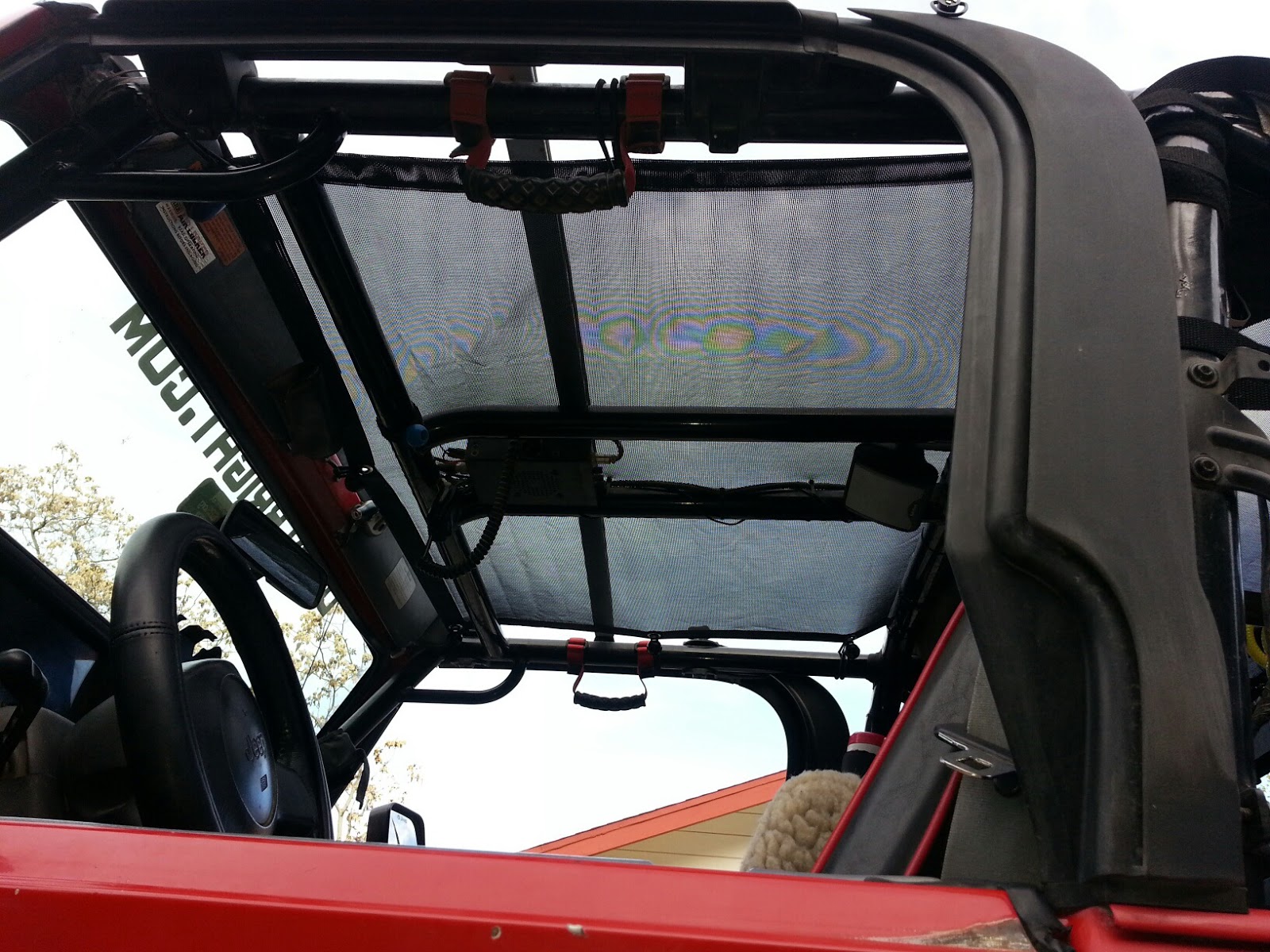
We installed the SpiderWebShade on Jeep Albright so we can go top down for the late spring and summer months, as long as the sun shines!  And what is cool is that it works just fine with our incredible Bestop SuperTop NX that we never really take all the way off, and our Safari Straps that serve as cargo netting.


The SpiderWebShade mesh top is well made, fits snug and doesn't flap around at high speeds.  We love it.


Looking from front to rear, this is how it fits.  Bungee ball cords hold the shade snug to your roll cage and Jeep upper structure.  This thing fits about anything.

Check out the fits, sizes and options for this skin-saving shade at:
http://www.spiderwebshade.com

We are top down and having a blast!

Del & Stacie

NEED A HANKIE? REMEMBER WHEN EVERY MAN HAD ONE?

A Handkerchief in Every Man's Pocket I had one of those random childhood memories pop into my head the other day. Handkerchiefs. Hankies...